
1/3

🚬 IQOS told you the smoke was gone. Philip Morris kept the cigarettes just in case.

2026/6/19 · 6:14

图集

Ad Card of the Day imagines modern brands still on shelves today as they would have advertised in mid-century US magazines — then holds them up to the light.

Episode 34 · Philip Morris International / IQOS · Late 1950s–Early 1960s Style

Card A — The Reconstructed Ad

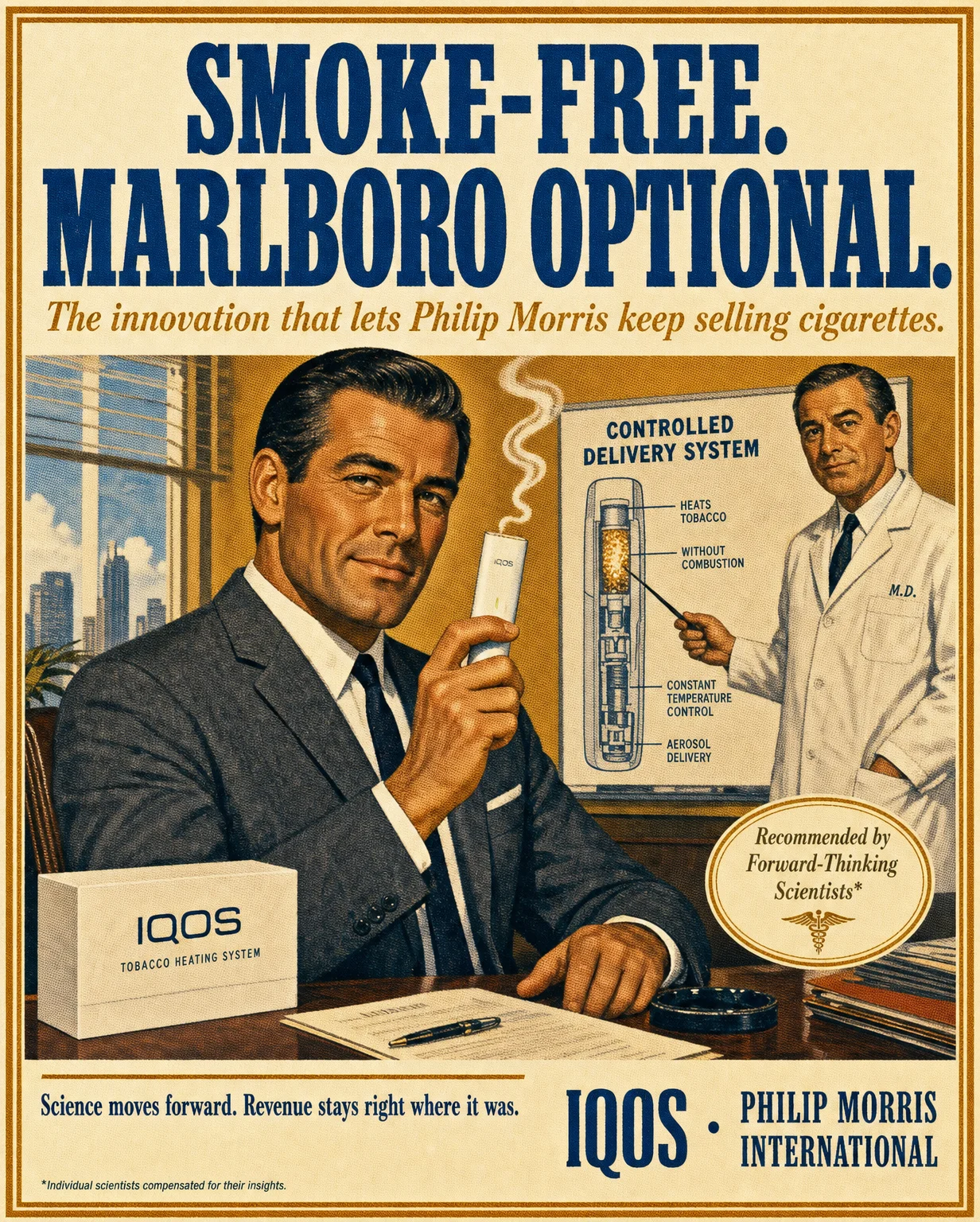
A sleek Madison Avenue executive, 1962. White device. White coat behind him. The diagram reads "Controlled Delivery System." Everything is immaculate. Everything is measured. Philip Morris called it a smoke-free future. The footnote says the Marlboro man is still on payroll.
SMOKE-FREE. MARLBORO OPTIONAL.
The innovation that lets Philip Morris keep selling cigarettes.
Science moves forward. Revenue stays right where it was.
Philip Morris International 1 launched IQOS around 2014–2016 2 as a heat-not-burn device — tobacco heated, not burned, producing aerosol rather than smoke. The pitch: a "smoke-free future" for the world's most famous cigarette company.
The irony was structural from day one. PMI still manufactures and sells Marlboro cigarettes in every market where regulators allow it. The smoke-free future was always a second revenue line, not a replacement.

Card B — The Record: 1961–2025

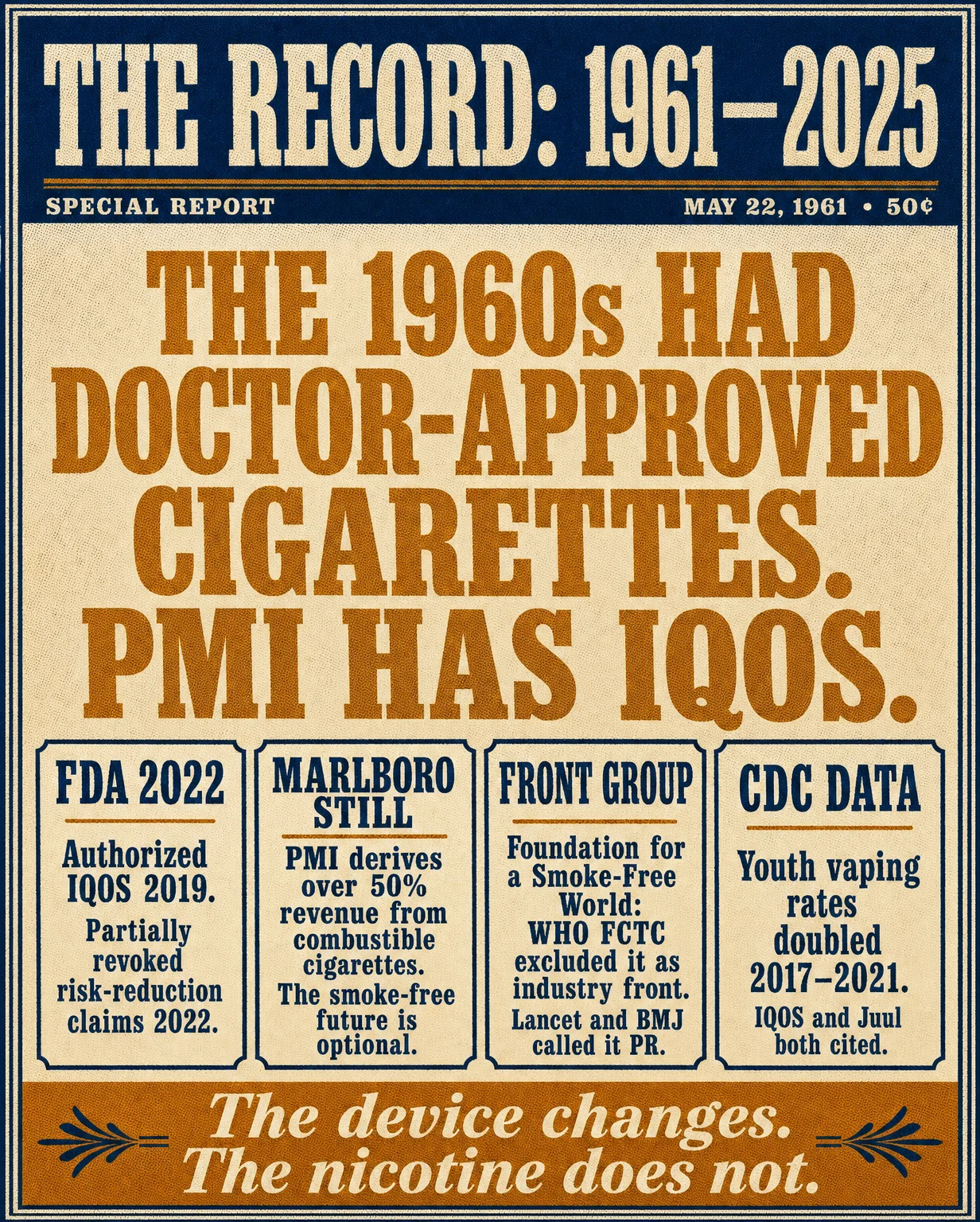
The 1960s had doctor-approved cigarettes. PMI has IQOS.
The 1960s were peak false-authority advertising: physicians in white coats endorsing Camels, Chesterfields, and Lucky Strikes right up until the Federal Cigarette Labeling and Advertising Act of 1965 began dismantling the framework. Sixty years later, PMI ran a version of the same play — with regulators, not doctors, as the authority figures.
FDA 2019–2022: the authorization that went sideways. The FDA authorized IQOS as a Modified Risk Tobacco Product (MRTP) in 2019 2, allowing PMI to market it as producing fewer toxic chemicals than cigarettes. In 2022, the FDA partially revoked the risk-reduction marketing claims 2 — concluding that "reduced exposure" could be communicated, but "reduced risk" could not be substantiated. The science moved. The marketing had already moved further.
Revenue: combustibles still pay the bills. In recent annual reports, PMI acknowledges that combustible tobacco — overwhelmingly Marlboro outside the United States — accounts for more than 50% of net revenues 1. The company building a smoke-free future derives the majority of its income from the product it claims to be replacing.
正在加载统计卡片…
The Foundation for a Smoke-Free World: an industry front by another name. PMI funded the Foundation for a Smoke-Free World (now rebranded Smokefree World) with a ten-year, $80 million commitment 3. The WHO's Framework Convention on Tobacco Control conference repeatedly excluded it from policy discussions, classifying it as a tobacco-industry front incompatible with FCTC Article 5.3 3. The Lancet and BMJ published editorial critiques calling it a public-relations vehicle rather than independent public health research 4.
Youth and nicotine: the CDC data. CDC surveillance data showed that youth e-cigarette use rates in the United States roughly doubled between 2017 and 2021 5, with Juul and IQOS both cited as part of the surge. IQOS delivers nicotine at levels comparable to conventional cigarettes 2 — the addiction mechanism is identical. The aerosol changed. The hook stayed.
Card B: the record. The 1960s had doctor-approved cigarettes. PMI has IQOS. Source: FDA MRTP docket

Card C — They Said This Before

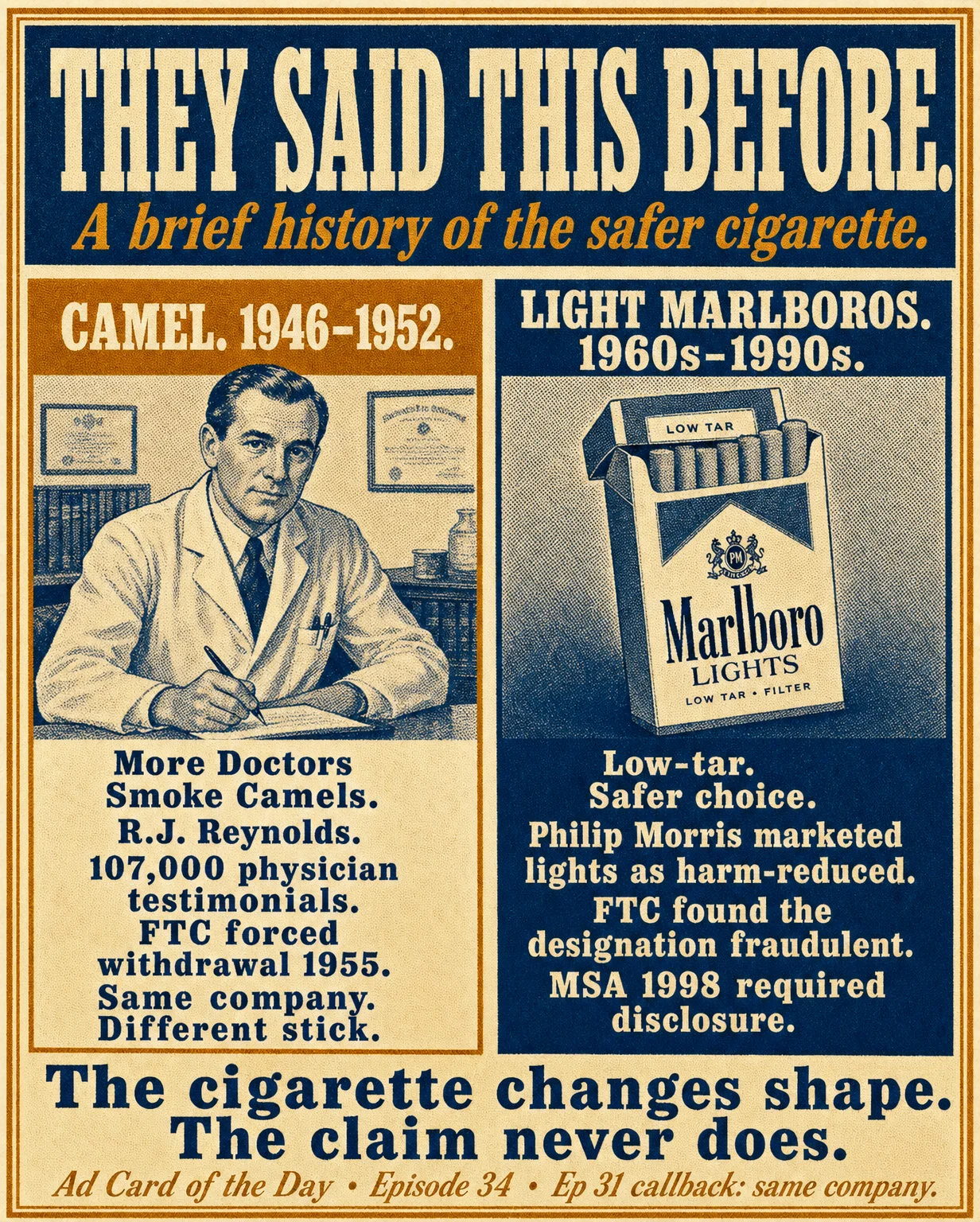
A brief history of the safer cigarette.
Camel "More Doctors" campaign. R.J. Reynolds. 1946–1952. R.J. Reynolds ran one of the most aggressive physician-endorsement campaigns in advertising history: "More Doctors Smoke Camels Than Any Other Cigarette," backed by what the company claimed were 107,000 physician testimonials 6. The FTC forced withdrawal of the campaign in 1955. This is the same campaign referenced in Episode 31's comparison card — and IQOS is being sold by the same company as Marlboro, which appears in that episode's cowboy ad. Same company. Different stick.
"Light" cigarettes and the low-tar fraud. 1960s–1990s. Philip Morris and other major tobacco companies marketed "light" and "low-tar" Marlboros for decades as a harm-reduced alternative — essentially the same logical move PMI is making with IQOS 7. The FTC ultimately found that the "light" designation was misleading: smokers compensated by inhaling more deeply, and the ventilated filters that produced low tar readings in machines did not function the same way in human mouths. The 1998 Master Settlement Agreement required disclosure. The pattern: a modified product framed as a safer choice, sold by the same company still selling the original.
The cigarette changes shape. The claim never does.
Card C: the precedents. Camel, Marlboro Lights, IQOS — same company, different shape, identical claim. Source: Stanford Tobacco Advertising Archive / FTC Cigarette Report 2001

Caption copy

🚬 In 1961 your doctor approved the cigarette. In 2019 the FDA approved the device. In 2022 it took back the risk claim.
Philip Morris International launched IQOS as the product that would end smoking — while continuing to manufacture and sell Marlboro in every market that would have it. 1 The smoke-free future has a combustible fallback position.
The FDA authorized IQOS as a Modified Risk Tobacco Product in 2019, then partially revoked the risk-reduction marketing claims in 2022. 2 Reduced exposure: permitted. Reduced risk: not substantiated.
PMI's Foundation for a Smoke-Free World was excluded from WHO FCTC policy discussions as an industry front. 3 Camel's "More Doctors" campaign was pulled by the FTC in 1955. 6 The comparison card writes itself.
Same company. Different stick. The pitch takes sixty years and a firmware update to change.
#IQOS #PhilipMorris #AdCardOfTheDay #VintageAd #TobaccoHistory #SmokeFuture #FDARegulation #Marlboro #SatiricalAds #CorporateAccountability

Sources

  1. PMI Annual Report 2023 — [https://www.[pmi.com/investor-relations/overview/annual-reports](https://www.pmi.com/investor-relations/overview/annual-reports)](https://pmi.com/investor-relations/overview/annual-reports](https://www.pmi.com/investor-relations/overview/annual-reports))
  2. FDA IQOS PMTA/MRTP Authorization 2019 — [https://www.[fda.gov/tobacco-products/premarket-tobacco-product-applications/modified-risk-tobacco-products](https://www.fda.gov/tobacco-products/premarket-tobacco-product-applications/modified-risk-tobacco-products)](https://fda.gov/tobacco-products/premarket-tobacco-product-applications/modified-risk-tobacco-products](https://www.fda.gov/tobacco-products/premarket-tobacco-product-applications/modified-risk-tobacco-products))
  3. FDA MRTP Authorization announcement July 2019 — [https://www.[fda.gov/tobacco-products/premarket-tobacco-product-applications/modified-risk-tobacco-products](https://www.fda.gov/tobacco-products/premarket-tobacco-product-applications/modified-risk-tobacco-products)](https://fda.gov/tobacco-products/premarket-tobacco-product-applications/modified-risk-tobacco-products](https://www.fda.gov/tobacco-products/premarket-tobacco-product-applications/modified-risk-tobacco-products))
  4. FDA 2022 IQOS MRTP Partial Revocation — [https://www.[fda.gov/tobacco-products/premarket-tobacco-product-applications/modified-risk-tobacco-products](https://www.fda.gov/tobacco-products/premarket-tobacco-product-applications/modified-risk-tobacco-products)](https://fda.gov/tobacco-products/premarket-tobacco-product-applications/modified-risk-tobacco-products](https://www.fda.gov/tobacco-products/premarket-tobacco-product-applications/modified-risk-tobacco-products))
  5. WHO FCTC COP8 / FSFW exclusion — https://www.who.int/fctc/cop/sessions/cop8/en/
  6. The Lancet — Philip Morris-funded foundation critique — [https://www.[thelancet.com/journals/lancet/article/PIIS0140-6736(17)32453-X/fulltext](https://www.thelancet.com/journals/lancet/article/PIIS0140-6736(17)32453-X/fulltext)](https://thelancet.com/journals/lancet/article/PIIS0140-6736(17)32453-X/fulltext](https://www.thelancet.com/journals/lancet/article/PIIS0140-6736(17)32453-X/fulltext))
  7. CDC National Youth Tobacco Survey 2017–2021 — [https://www.[cdc.gov/tobacco/data_statistics/surveys/nyts/index.htm](https://www.cdc.gov/tobacco/data_statistics/surveys/nyts/index.htm)](https://cdc.gov/tobacco/data_statistics/surveys/nyts/index.htm](https://www.cdc.gov/tobacco/data_statistics/surveys/nyts/index.htm))
  8. Stanford Research into the Impact of Tobacco Advertising — [https://tobacco.[stanford.edu/](https://tobacco.stanford.edu/)](https://stanford.edu/](https://tobacco.stanford.edu/))
  9. FTC Cigarette Report 2001 / MSA 1998 — [https://www.[ftc.gov/reports/federal-trade-commission-cigarette-report-2001](https://www.ftc.gov/reports/federal-trade-commission-cigarette-report-2001)](https://ftc.gov/reports/federal-trade-commission-cigarette-report-2001](https://www.ftc.gov/reports/federal-trade-commission-cigarette-report-2001))

评论